Who sets the standards in the IT world?
From IBM Stability to Cloud Flexibility: The Data Center Path
The Age of the Monolith: IBM's Reliability Architecture
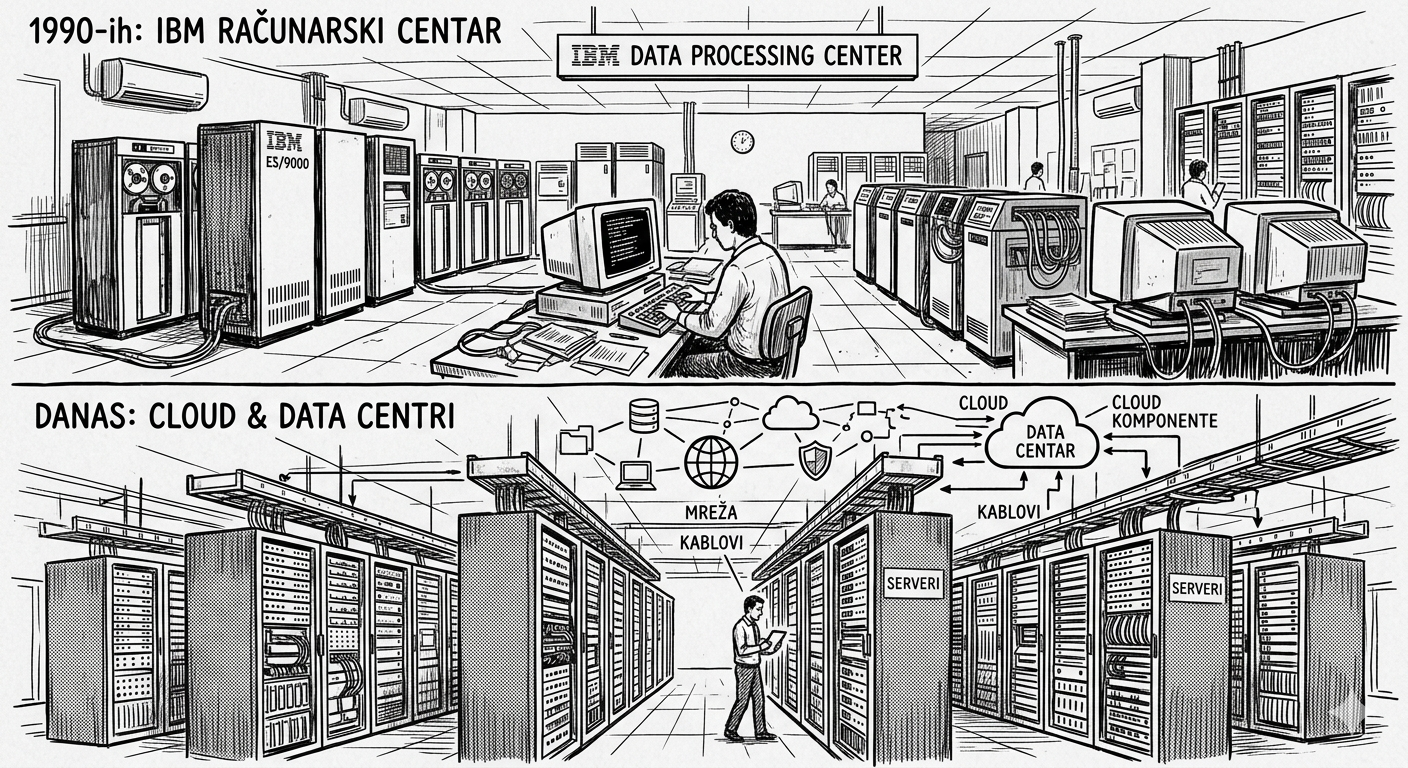
Let's go back to the era when mainframe systems, especially IBM's, were synonymous with corporate computing. These systems represented the pinnacle of engineering, offering incredible stability and reliability. Vertical integration, where one company controlled the hardware, operating system and key software, allowed for the level of optimization and control that was necessary for critical applications of the time.
IBM's specifications were de facto rules. Scaling meant investing in powerful, expensive, but extremely reliable systems. While this meant some lock-in, it also provided peace of mind to corporations that depended on their systems running smoothly. IBM was a pillar of reliability, and their vision shaped the early data center landscape.
Unthinkable Transformation: How the Cloud Seemed Impossible
Back then, the idea that the centralized power of these systems would move to an abstract, distributed "cloud" seemed like science fiction. It was unthinkable that sensitive data, protected behind the walls of corporate data centers, would be entrusted to a third party. Security, latency and data sovereignty issues were insurmountable challenges.
However, technological advances, particularly in networking and virtualization, combined with the need for greater flexibility and speed of innovation, have driven this transformation. What once seemed impossible has become the foundation of the modern digital world.
Today: Who's Setting the Standards in the Cloud Age?
In today's data center landscape, the dominant players are Amazon Web Services (AWS), Microsoft Azure, and Google Cloud Platform (GCP). However, the question of who sets standards no longer has a simple answer. It is no longer one giant, but a complex ecosystem:
Community and Open Source: Technologies such as Linux, Kubernetes and Docker, which form the basis of cloud native applications, are developed through global communities and foundations (such as the Cloud Native Computing Foundation - CNCF). They define interoperability and architectural concepts.
Collaboration and Standardization: Organizations such as the Open Compute Project (OCP) and the IETF (Internet Engineering Task Force) are places where competitors come together to define hardware and network specifications, focusing on efficiency and sustainability.
Market Adoption: Although each vendor has its own specific APIs and services, certain concepts (such as object storage, serverless computing, virtual private networks) are becoming standardized through widespread adoption. The market, not a single vendor, dictates what works best.
In the eighties of the last century, one of our most prominent professors of information systems, prof. Dr. Branislav Lazarevic, asked the students the famous question:
"Who sets the standards in the IT world?"
Since no one knew the correct answer, the professor made a point by saying that it was done by whoever was the strongest — at that time, the undisputed IBM.
Has anything changed?